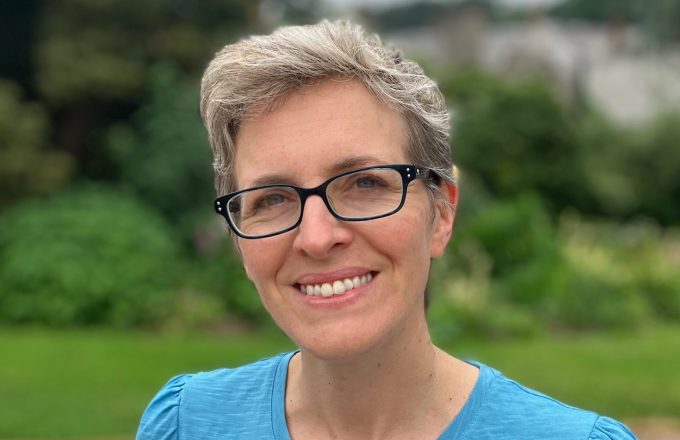
Alongside her clinical role as a consultant in Acute Medicine at Torbay Hospital, Dr Alice Miller is a Knowledge Mobilisation Fellow with ARC South West. Through her fellowship, Alice is exploring how research evidence can be translated into the complex, real-world context of the NHS, while also contributing to wider work around workforce wellbeing.
In this Q&A, Alice shares her experience of the fellowship, what she has learned about bringing research and practice together, and why listening, collaboration and storytelling are so important to effective knowledge mobilisation.
ARC South West Knowledge Mobilisation Fellowship
Can you tell us a bit about your role and what made you apply to become an ARC South West Knowledge Mobilisation Fellow?
I am a part-time knowledge mobilisation fellow alongside my clinical role as a consultant in Acute Medicine at Torbay Hospital. I wanted to find a way to make a positive impact on the healthcare system beyond my own department and organisation, while broadening my horizons and keeping my work sustainable and enjoyable. I got in touch with Professor Karen Mattick to ask about academic possibilities. She identified the option of a Knowledge Mobilisation Fellowship, specifically to help with translation of research evidence from the Care Under Pressure studies into the messy reality of the NHS.
What have you enjoyed most about being a Knowledge Mobilisation Fellow?
The most enjoyable bit for me has been the learning – about myself, other people, knowledge mobilisation, the healthcare system in which we work, philosophy, and so much more. Knowledge mobilisation is all about people and how we connect, and I love that aspect of the field.
Has being a Fellow changed the way you think about sharing research or working with other? If so, how?
Absolutely. As clinicians, we often think that knowledge mobilisation or translation is a linear process from academic to practitioner – but it is now abundantly clear to me that this is not the case. Knowledge mobilisation is a conversation, or a series of conversations, involving a whole community. Listening out for quiet or seldom-heard voices is crucial. I have also started to recognise the importance of stories and storytelling in knowledge mobilisation.
What would you say to someone who’s thinking about applying for the Fellowship?
I would encourage them. There is a lot to learn, and in learning, you can bring people with you. The UK knowledge mobilisation community is a welcoming and diverse place, and there are many opportunities for connection and collaboration.
Sharing insights on NHS workforce wellbeing
Alongside her fellowship, Alice has also contributed to the CARES-Well workforce research partnership, exploring how we can better understand and improve wellbeing across the NHS. Here, Alice reflects on the inspiration behind her blog, Key Stakeholders in NHS Workforce Wellbeing, and the importance of building relationships, listening to different perspectives and recognising that there is no one-size-fits-all approach to supporting staff wellbeing.
What inspired you to write this blog?
The organisation of the NHS is quite complicated and confusing, sometimes even to those working within it. We wanted to offer some tips for those embarking on projects around workforce wellbeing, highlighting some of the key stakeholders involved in decision-making about staff wellbeing within the NHS.
What are the main messages you wanted people to take away from it?
Our main message is around relationship-building and prioritisation of dialogue between groups and individuals within the wellbeing community of an organisation. The NHS loves checklists and toolkits, but in this particular area, context is everything.
Why do you think it's important to involve different people and organisations when improving NHS staff wellbeing?
In NHS workforce wellbeing, one size very much does not fit all. Diversity of input is absolutely vital if we are to understand the issues affecting wellbeing of staff. Co-design of interventions or co-production of solutions to wellbeing problems is also much more likely to be effective and sustainable than a toolkit produced externally.
Who do you hope reads the blog, and what would you like them to do differently after reading it?
I really hope that we can get an audience from clinical wellbeing champions and senior leaders within NHS organisations, as well as researchers working in the field of workforce wellbeing. There is a strong link between positive organisational culture and wellbeing of staff, and culture is set by all of us; I want to encourage our readers to get involved in improving working lives for NHS staff, one step at a time.
Read 'Key Stakeholders in NHS Workforce Wellbeing: An Orientation Guide' hereContributing to a BMJ Quality & Safety editorial
Alice was also asked by lead author, Alison Pearson, to contribute her clinical perspective to a BMJ Quality & Safety editorial exploring the importance of professional support for clinicians working within an increasingly pressured NHS. Drawing on her experience as a clinician and supervisor of resident doctors, Alice reflects on the practical implications of the guidance and the wider pressures facing NHS staff.
What was it like working with the other authors on the piece?
We didn’t have time to meet face-to-face, so we worked together over email and MS Teams. Alison took responsibility for the majority of the editing, so she made the process very easy for me. My main contribution was to think about the practical implications of the professional support guidance we were considering, while Kathryn and Alison focused on the academic literature around the subject.
What do you hope people take away from the editorial?
I think it is vital that we start paying attention to the implications of working in today’s NHS. Organisations need to do what they can to mitigate for systems which are at or beyond capacity; personal or team resourcefulness is no longer enough.
How does the editorial link to your wider work on NHS workforce wellbeing?
In the editorial, we highlight the impact of system pressure on individual clinicians (doctors, in this case), and how it can lead to the need for professional support. The same system pressure is felt across the whole NHS workforce, and yet there is still more emphasis on individual resilience in maintaining wellbeing, rather than it being an organisational responsibility. The Desmond Tutu quote is apt, because we have persistently ignored what is happening upstream. The CARES-Well workforce research partnership aims to change the narrative, by working with partners in health and social care to identify how to create healthy workplaces where staff will want to work, feel productive and can thrive.